Inspired by old crime TV, British designer Alex Carpenter's Drop Dead Rug was such a hit at the London Design Festival in 2005 that he took it into production.
Mimicking the shape of "an unfortunate soul which may have come to pass right there on your living room floor with their silhouette remaining as evidence," the throw is a dark red felt with a light grey band running around the edge to depict the chalk line.
It was available at the time for £150 and quickly sold out.
Mom always said to leave them out to cool to room temperature before putting them in the fridge.
Mom also said that reading in bad light would hurt your eyes.
Mom was wrong both times.
Maybe more — but let's not be haters: after all, look how well you turned out.
Erm... maybe it's time to move on.
Okay then, on to Anahad O'Connor's "Really?" feature in the New York Times, which addressed the very question raised in the headline up top.
The Claim: Hot Leftovers Should Cool at Room Temperature
The Facts: What to do with leftovers? One common bromide is that leftovers stored in the refrigerator must be allowed to cool first at room temperature.
The reasoning behind the claim varies. One theory is that allowing food to cool at a slower rate reduces the likelihood that it will spoil. Another suggests that hot food can somehow interfere with the circulation of cold air in the refrigerator. The notion may have originated back when food was stored in iceboxes, and thus could not be too hot when put away.
Whatever the rationale, the claim is wrong. According to the Food and Drug Administration, leftover food (particularly meat) should be refrigerated immediately after serving, and certainly within two hours of cooking.
Food bacteria can double every 30 or 40 minutes, and several outbreaks of food poisoning have been linked to meat cooked and left to cool at room temperature for too long.
Generally, the bacteria that contaminate food thrive at temperatures between 40 and 140 degrees Fahrenheit, so leftovers should always be stored in a refrigerator set at 40 degrees or below.
When the quantity of food is large, it should be separated into small containers for quicker cooling, and reheated no more than once.
The Bottom Line: It's a bad idea to let food sit at room temperature before refrigerating.
So simple even I can do it: Wipe the inside of the glasses with a cloth or paper towel.
A report by French scientists published in the Journal of Agricultural and Food Chemistry showed that wiped glasses show "an excess of effervescence" due to the hollow cellulose fibers that get displaced from a cloth or towel acting as "nucleation" (bubble formation) sites.
from madamjujujive, grand panjandrum of EVERLASTING BLÖRT, one of the very longest lived websites still standing (since 2001!), I took a flutter on Wrap City Chips.
Long crunchy story short: I agree with her assessment.
Full disclosure: I love potato chips and have long pursued and tried zillions of brands in search of greatness.
About 15 years ago I reported on an in-depth potato chip tasting (around 10 different small-batch/company brands) with another aficionado.
As best I recall, the winner was a company that sliced its potatoes (peel on) not in the customary way but rather along the long axis, yielding humongous slices that when fried were incredibly good.
Alas, they went out of business.
I wish I could remember the company's name... they were based somewhere in the east, New Jersey/Pennsylvania....
But I digress.
Today and henceforth, these are my potato chips of choice.
Lagniappe: My chips arrived around 5pm during a thunderstorm; the delivery guy put the box on my front stoop where it sat overnight, only coming to my attention the next morning when I saw the delivery confirmation in my email.
"Yikes!", I thought — "What if they were all wet and soggy from the rain?"
The box was plenty damp and soft; to my delight, however, Wrap City's packaging consists of a heavy paper bag completely lined with the same clear plastic they use for the front window (see video up top).
The chips were perfectly crunchy, no moisture effects whatsover.
Casio's history can be traced back to its roots: the "ring cigarette holder" (top) invented by Kashio [see what they did there?] Seisakusho.
Launched in 1946, it caused a sensation in Japan in the early postwar period, achieving great commercial success and providing crucial financial support for the later development of Casio calculators.
"This map show the predicted density of underground networks created by arbuscular mycorrhizal fungi. These networks form one of Earth's circulatory systems, moving massive amounts of carbon, nutrients, and water across plant communities."
This new concert film was the first time I'd ever heard a Billie Eilish song.
Long story short: I loved the movie.
I have a jones for live concert films, most of all those featuring Taylor Swift but also past ones like "Stop Making Sense," "Gimme Shelter," "Woodstock," "The Song Remains The Same," etc.
James Cameron — yes, that James Cameron — was actively involved in the making of this movie and often appears on camera, filming Eilish as he interviews her.
I warmed to her songs and performance as the concert progressed (unlike the concert films of Taylor Swift, which feature many shows across continents as she makes her world tours, Eilish's features just one concert along with the entire day's preparation, sound checks, etc.).
She is really something, holding the stage for the most part completely alone, unlike Swift without a highly choreographed troupe of dancers and singers surrounding her and complete changes of outfit and mood and stage sets and lighting between songs.
The bond between her arena audience and her is amazing to see.
She's also quite articulate and insightful during the Cameron interviews.
Make sure you livestream it to your friends back on Earth (allow 3-24 minutes travel time, depending on where the two planets are in their respective orbits).
NASA's Curiosity Rover saw this on June 11, 2026.
It initially captured 11 individual photos of a sand-capped butte, nicknamed "Miraflores," with its mast camera.
The isolated feature is about 20 feet tall.
It was left behind when surrounding rock eroded, deepening the broad valley Curiosity was in.
The photos were sent back to Earth and stitched together, producing a high-resolution (6,162 x 2,576 pixels) image.
The color was adjusted to match the lighting conditions as the human eye would see if a person were standing on the surface of the Red Planet next to Curiosity.
In the photo below, you can see the butte in the distance.
The area pictured is inside the 96-mile-wide Gale Crater, in which sits Mount Sharp, an 18,000-foot-high central peak that rises from the crater.
"Billions of years ago, lakes and streams dappled the lower foothills of Mount Sharp, which Curiosity has been ascending since 2014," noted NASA.
This unique access hatch featuring a six-part cover over a built-in spiral staircase is located on Bahnhofsplatz/Gustav-Stresemann-Ring in Wiesbaden, Germany.
It opens down into the historic Salzbachkanal (Salzbach Canal) — the main underground stormwater and drainage sewer system for Wiesbaden's city center.
The staircase is roughly seven meters high, opening into the brick-arched canal below.
According to the city's own records, the subterranean canal was built between 1900 and 1907, following typhus epidemics that pushed the city to modernize its sewage system.
It was designed by engineers Josef Brix and Martin Frensch.
The heavy metal cover features segmented triangular folding lids that open outward, revealing a cylindrical brick-lined shaft with a tightly fitted spiral staircase.
The cover was designed specifically to fit this construction's access shaft.
It serves as a specialized maintenance and descent shaft for municipal engineers inspecting or working within the subterranean drainage network.
The city has an annual "Day of the Open Canal" on which public tours are offered.
Out there on the patio — it's a bird, it's a plane, it's... my can holder?
Yes.
I saw it in a Seven-11 many years ago and instantly raced to grab it before anyone else could.
No better summary exists of my take on things — then or now.
For $1.99 or whatever it cost I get at least one laugh and many smiles each day, every time I see it — which is often since I drink a lot of Caffeine-Free Diet Coke and as a result visit the WC frequently.
My philosophy (long story short): If you can't laugh at yourself, you have no business laughing at anyone else.
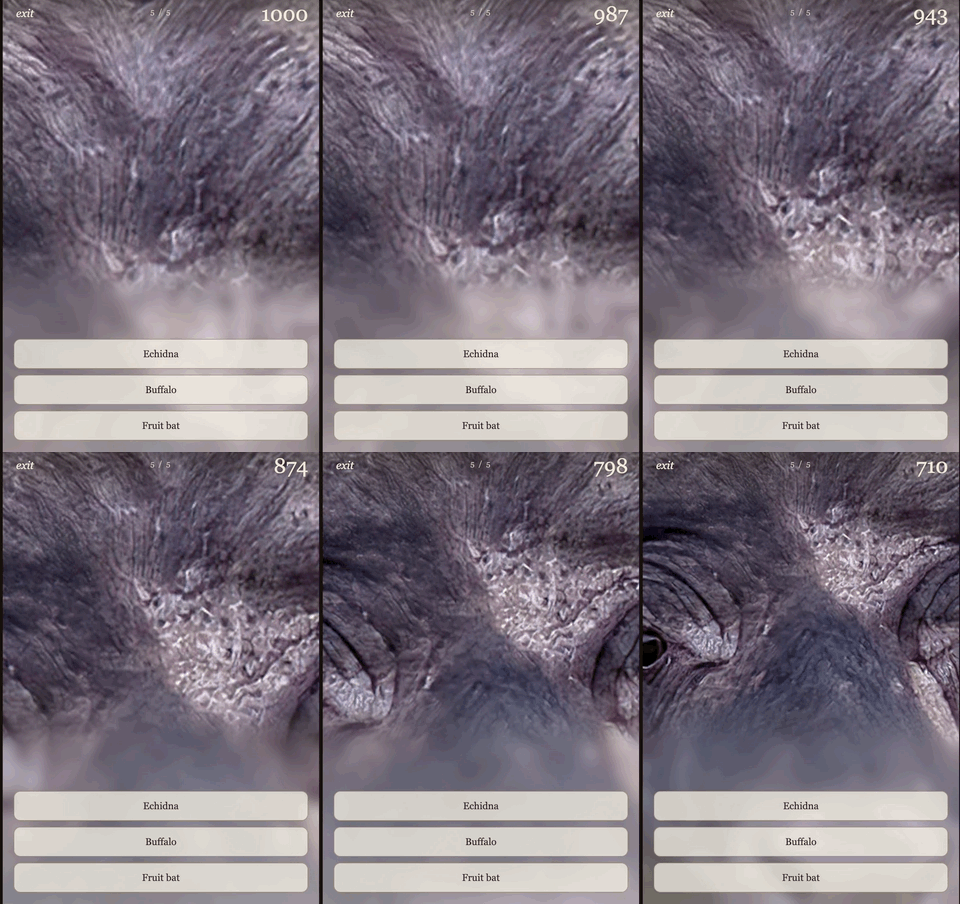
It’s fun! By forcing you to look so closely at the zoomed-in features of these critters, it gets you to see them with fresh eyes … a nice aesthetic and existential effect.
You can pick a category of “birds”, “dogs”, or “all animals”, which I picked above. You can play against friends, racing to see who’s first to identify the game, or just do it in solo mode.
Using high-definition open source videos and photos from NASA, John Boswell created this 8-minute-long video recap of this past April's Artemis II mission that executed a flyby of the moon, marking the furthest man has ever been from Earth.
Can't wait to watch this on Vision Pro's YouTube app: the device's micro-OLED panels each produce a 4K image which together deliver 6K resolution — not 8K, a common misconception since two 4K panels don't yield 8K in pixel-count terms.
Her latest? A plant inside a bell jar that contains a grow-light. There’s a slot at the bottom of the bell jar, into which she slides her phone. The grow-light only goes on if the phone is in the slot — so, in essence …
There's something kind of poetic about it. Like if I'm on my phone, I'm not only taking away from my own life, I'm also taking away from the life of this plant.
This idea has promise.
Giertz has only made this one-off prototype, but I bet she could bring it to market.